
Freelancing often starts with something simple.
A designer takes on a few clients after work. A writer lands a project through a referral. A consultant helps a business solve a problem and gets paid directly.
At first, it feels like extra income.
Then something changes.
The side work becomes consistent. Clients start arriving every month. Income grows. Responsibilities grow with it.
This is usually the point where freelancers begin asking an important question:
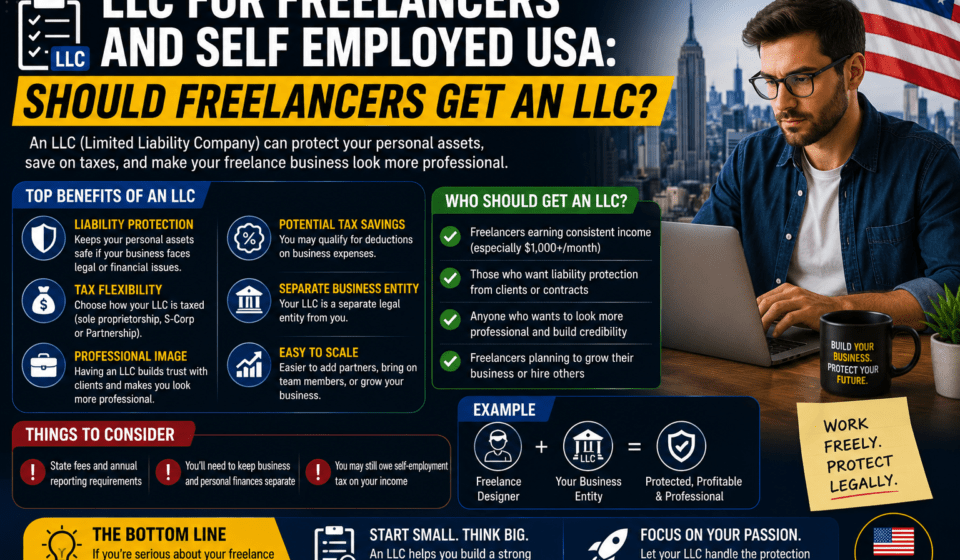
Should freelancers get an LLC USA?
It is a reasonable question because forming an LLC costs money, requires paperwork, and introduces new responsibilities. At the same time, staying unprotected can create risks many freelancers do not notice until a problem appears.
The answer is not always the same for everyone. It depends on your income, your risk level, your future plans, and the type of work you do.
This guide explains what freelancers actually need to know before making that decision.
Why Many Freelancers Consider an LLC
When people first start freelancing, they often operate as sole proprietors without realizing it.
They invoice clients, receive payments, and report income on their taxes.
There is nothing wrong with this approach in the beginning.
The challenge is that many freelancers continue operating this way long after their business has become established.
A freelance writer handling large corporate clients faces different risks than someone earning occasional side income. A consultant advising companies on business decisions carries different responsibilities than a hobbyist taking small projects.
As income grows, the conversation shifts from earning money to protecting what you have built.
That is where an LLC for freelancers and self employed USA becomes relevant.
What an LLC Actually Does
Many articles focus entirely on legal protection.
That is important, but it is only part of the picture.
An LLC creates a separate legal entity between you and your business.
Without an LLC, you and your business are generally viewed as the same entity.
With an LLC, there is a legal separation.
This distinction matters when contracts, disputes, debts, or legal claims enter the picture.
Limited Liability Protection Matters More Than People Think
Imagine you are a freelance marketing consultant.
A client claims your recommendations caused financial losses and decides to pursue legal action.
Or perhaps you are a web designer whose client alleges that a project failure harmed their business.
These situations may be rare, but they happen.
Limited liability protection helps create a layer between your personal assets and business obligations.
While no structure guarantees complete protection in every circumstance, an LLC often provides significantly better safeguards than operating as a sole proprietor.
The Professional Credibility Factor
One benefit competitors often overlook is perception.
Many freelancers focus exclusively on liability protection while ignoring how clients view them.
A freelancer LLC USA can create a stronger professional image.
Large companies frequently prefer working with registered businesses.
Some procurement departments and corporate clients feel more comfortable signing contracts with a formal business entity.
I have seen freelancers land larger projects simply because their business appeared established and organized.
Clients often assume that businesses with proper registration, contracts, and systems are more reliable.
The LLC itself does not create expertise.
It does create confidence.
Freelancer LLC vs Sole Proprietorship USA
This comparison is where many freelancers get stuck.
A sole proprietorship is simple.
There are usually no formation costs. Administrative requirements remain minimal. Tax filing is straightforward.
An LLC introduces costs and responsibilities.
You may need state filings, annual reports, and ongoing compliance depending on your location.
The decision comes down to balancing simplicity against protection and growth.
When a Sole Proprietorship May Be Enough
Someone earning a few thousand dollars annually from occasional freelance projects may not immediately need an LLC.
The risk level remains relatively low.
The business is still being tested.
In this situation, keeping things simple can make sense.
When an LLC Starts Making Sense
The picture changes when freelance income becomes meaningful.
If clients rely on your work, contracts become larger, or your business becomes a significant income source, an LLC deserves serious consideration.
This is especially true for consultants, marketers, developers, designers, coaches, and other professionals whose work directly impacts client outcomes.
Do I Need an LLC as a Freelancer USA?
This question appears constantly in online forums.
The better question is this:
What happens if something goes wrong?
Many freelancers focus on monthly income and ignore downside risk.
Business decisions should account for both opportunity and protection.
Ask yourself:
Would a client dispute create financial stress?
Would losing personal savings significantly affect your life?
Are you signing contracts with larger organizations?
Are you planning to grow your freelance work into a long term business?
The more often you answer yes, the stronger the argument for forming an LLC.
Common Mistakes Freelancers Make
One mistake appears repeatedly.
They mix personal and business finances.
Money comes into a personal account. Expenses leave the same account. Tracking becomes difficult.
This creates accounting challenges and weakens business organization.
Opening a business bank account LLC is one of the simplest improvements a freelancer can make.
It creates cleaner records and supports better financial management.
Another common issue involves waiting too long.
Some freelancers postpone business decisions because everything seems fine.
Then a major client arrives, income increases rapidly, and they scramble to build proper systems under pressure.
Planning ahead is usually easier than reacting later.
Self Employed Taxes USA and LLC Considerations
Taxes often create confusion.
Many freelancers assume forming an LLC automatically reduces taxes.
That is not necessarily true.
A standard single member LLC typically uses pass through taxation LLC treatment.
Business profits pass through to the owner’s personal tax return.
The tax structure may initially resemble a sole proprietorship.
The potential advantages become more relevant as income grows and additional tax elections become worth considering.
This is where guidance from a small business tax advisor USA becomes valuable.
Tax planning should be based on actual numbers, not internet myths.
When Should a Freelancer Form an LLC?
There is no perfect income threshold.
Different businesses face different risks.
However, certain signs suggest the timing may be right.
You regularly sign client contracts.
You depend on freelance income for a significant portion of your livelihood.
You are building a long term business rather than testing an idea.
You want stronger separation between personal and business finances.
You are pursuing larger clients.
At this stage, the benefits of LLC for freelancers USA often outweigh the costs.
LLC for Freelance Writers, Designers, and Consultants
Different freelance professions face different realities.
A freelance writer may face lower legal risk than a consultant advising companies on strategic decisions.
A designer working with trademarks and branding may encounter different challenges than a virtual assistant.
The common thread is that professional responsibility increases as client relationships become more important.
An LLC for freelance writers USA may be appropriate at one income level.
An LLC for consultants and freelancers USA may become necessary much sooner due to higher risk exposure.
The answer depends on the nature of the work, not just revenue.
How to Start an LLC as a Freelancer USA
The process itself is usually straightforward.
Most freelancers begin by choosing a business name and filing formation documents with their state.
They obtain an EIN number USA, open a business bank account, and create systems for managing income and expenses.
Many entrepreneurs start by learning how to register LLC in USA and understanding the LLC formation process USA before moving forward.
The key is doing it correctly rather than rushing through paperwork.
Is an LLC Worth It for Freelancers?
For many established freelancers, yes.
The value extends beyond liability protection.
An LLC encourages professional habits.
It supports cleaner financial management.
It can improve credibility with clients.
It creates a stronger foundation for future growth.
That does not mean every freelancer needs one immediately.
Someone earning occasional side income may reasonably wait.
Someone building a serious business often benefits from acting sooner.
Looking Beyond Today
One mistake people make is evaluating business decisions based only on current circumstances.
Think about where your business may be in two years.
Will you hire contractors?
Will you pursue larger clients?
Will you expand services?
Will freelancing become your primary income source?
The answers help determine the best business structure for freelancers USA.
The goal is not simply solving today’s problem.
The goal is creating a structure that supports future growth.
Final Thoughts
The question should freelancers get an LLC USA does not have a universal answer.
For some freelancers, staying a sole proprietor is perfectly reasonable during the early stages.
For others, an LLC becomes an important step toward protecting income, building credibility, and creating a stronger business foundation.
The key is making the decision intentionally rather than delaying it out of uncertainty.
If your freelance work is becoming a real business, it may be time to treat it like one.
A well structured business does not guarantee success.
It does make growth easier to manage and risks easier to control.
That peace of mind is often worth far more than the filing fee.